Personal Financial Planning

Comprehensive and dedicated personal financial planning service
focused on building a COMPREHENSIVE financial STRATEGY
for every stage of life

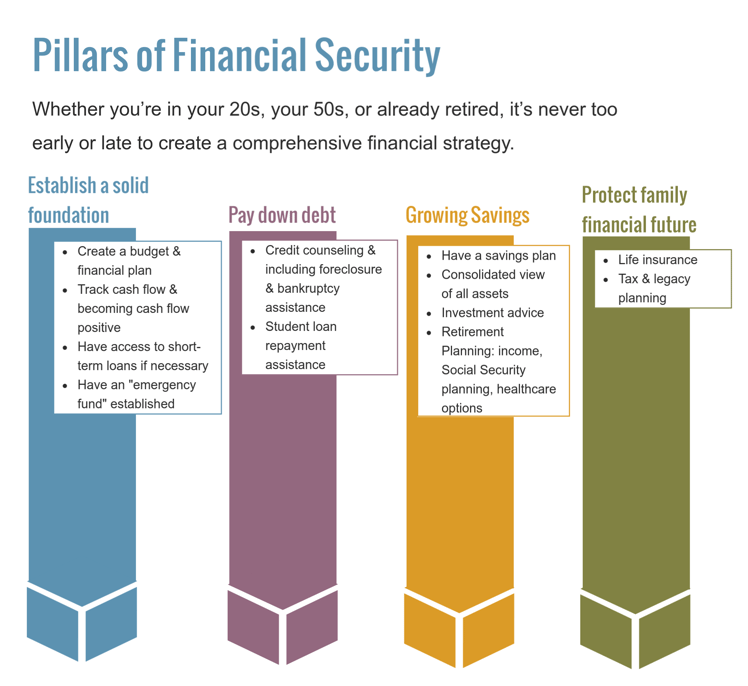
Pillars of Financial SecurityWe take a holistic approach to our personal financial planning service. We learn about you and your resources and goals to create an individualized strategy addressing where you are now and where you want to be. With a clear view of your specific needs, we can begin building your financial plan.

True financial success involves putting together all the individual pieces that make up your personal financial puzzle. Based on your needs, we can create a detailed plan for you that includes the following areas:

  • retirement planning
  • social security
  • debt management
  • budgeting
  • goal planning
  • cash flow planning
  • general and holistic financial planning

A successful plan for your long-term financial wellness is more than your investments and available cash. We will work together with your tax, estate, and insurance service providers to ensure your investment management and financial planning services are on the same path to work together cohesively.

Frequently Asked Questions

Q: When is the best age to claim Social Security and coordinate Medicare?

A: There is no universal "right age" to claim Social Security. The optimal timing depends on your health, anticipated longevity, tax bracket, and other income sources. We evaluate your Social Security claiming strategy within the context of your broader retirement roadmap, coordinating it alongside Medicare enrollment decisions, pension options, and portfolio withdrawals to maximize your lifetime, after-tax benefits. 

Q: How will my retirement income be taxed across my different accounts?

A: Taxes do not stop in retirement; how and when you pull money from pre-tax (401(k)/traditional IRA), tax-free (Roth), and taxable accounts directly affect how much you keep. We implement proactive, multi-year tax planning strategies—such as evaluating Roth conversions and managing income brackets over time. While we do not file tax returns directly, we actively coordinate with your CPA or tax professional to ensure your investment allocations and withdrawal sequencing remain as tax-efficient as possible.  

Q: What should I do with my 401(k) and employer accounts when I retire or change jobs?

A: Managing multiple employer plans, IRAs, and brokerage accounts from past employers often creates unnecessary fragmentation and overlap. During our initial process, we review your existing plan balances, evaluate rollover options versus leaving funds in place, and consolidate accounts where appropriate. This brings organization to your balance sheet and aligns your total asset allocation with your long-term income goals. 

Q: What is a fiduciary and why does it matter?

A: A fiduciary is someone that must act in your best interest. For investment advisors, the Securities and Exchange Commission (SEC) states:

“This means that you have a fundamental obligation to act in the best interests of your clients and to provide investment advice in your clients’ best interests. You owe your clients a duty of undivided loyalty and utmost good faith. You should not engage in any activity in conflict with the interest of any clients, and you should take steps reasonably necessary to fulfill your obligations.”

Most people assume that the financial professionals they work with are going to follow that definition and work solely in their best interests. Unfortunately, not all advisors have to follow the SEC’s definition and the SEC has not done a very good job of helping consumers differentiate between those who serve their clients as fiduciaries and those who don’t.

Within the investment industry, individuals are licensed either as investment adviser representatives or registered representatives.

  • An investment adviser representative is affiliated with a registered investment advisor (RIA), and the company and individual must serve as a fiduciary to the clients they serve.
  • Registered representatives work for a broker-dealer and may provide similar services as an RIA but they do not have to work in your best interests as a fiduciary. Instead, they represent the broker-dealer and are usually compensated through commissions for selling products to you.

To make matters even more confusing, many investment adviser representatives and registered representatives use similar titles such as “wealth manager” or “financial consultant.” And in some cases, professionals are registered as both, switching “hats” between serving as a fiduciary, or not, depending on the client they work with and the specific service they are providing.

If you are working with an advisor or evaluating hiring a new advisor, they should be able to clearly state that they will serve you as a fiduciary. Multnomah Group is registered with the SEC as a registered investment advisor and serves our clients as a fiduciary. We are not affiliated with any broker-dealer and have no ability to earn any commissions for selling products. We believe this model reduces conflicts of interest and frees our employees to provide the best possible advice to our clients.

Contact Us


Jake Larson_720px

Jake Larson, CFP®

Financial Advisor

Scott Cameron_250px

Scott Cameron, CFA

Principal

Learn More About Our
Personal Financial Planning Service


For more information on how Multnomah Group can help you, please provide the information below and you will receive an email with more information about our Personal Advisory Service.


Latest from the Blog

ERISA Fraud Case: TPA CEO Pleads Guilty to Stealing More Than $8 Million from Employee Benefits Plans

Article Key Takeaway A recent criminal case involving a third-party administrator (TPA) highlights the Employee Benefits ... Read more

Beyond the Perimeter Chapter 6: Insurance, Crypto, and the Edges of the DC Investment Menu

Not all perimeter shifts involve private equity. Many of today’s most common DC options—stable value, guaranteed income ... Read more

Featured Webinars

Upcoming Webinar: 2026 Retirement Plan Regulatory Update

The regulatory landscape continues to evolve, creating new challenges and opportunities for retirement plan fiduciaries. Join us for our 2026 Regulatory Update webinar, where we'll discuss the most significant developments affecting retirement plans and the practical steps plan sponsors should consider before year-end.

Read more

Looking for something else?