The Compliant Foundation
A stronger retirement plan starts with a stronger foundation. Download The Compliant Foundation to learn how governing documents, provider structure, and fiduciary oversight create the framework for long-term plan success
Thought leadership with plan fiduciary education in mind
A stronger retirement plan starts with a stronger foundation. Download The Compliant Foundation to learn how governing documents, provider structure, and fiduciary oversight create the framework for long-term plan success
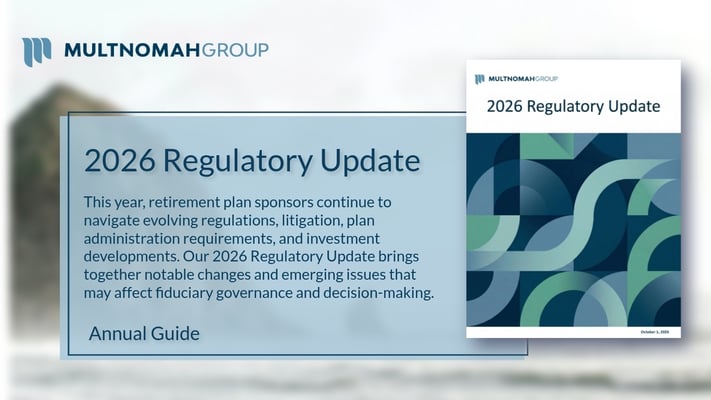
The regulatory landscape continues to evolve, creating new challenges and opportunities for retirement plan fiduciaries. Our 2026 Regulatory Update discusses the most significant developments affecting retirement plans and the practical steps plan sponsors should consider before year-end.
The 2026 Regulatory Update summarizes significant legal, regulatory, legislative, and investment developments affecting retirement plan sponsors and fiduciaries. It covers ERISA litigation, Department of Labor guidance, IRS requirements, proposed federal legislation, and the growing use of private-market investments and guaranteed-income products in defined contribution plans.
Each year, we gather fee data from the different providers our clients utilize as recordkeepers for their plan(s). We compile the information and produce a report outlining the fees paid for recordkeeping the plan and benchmark those fees against peer group ranges.
Governmental retirement plans operate without a safety net. For many participants, these plans represent their most important financial institution, and often their only path to retirement security. In "Governing Without a Safety Net," we explain how thoughtful governance frameworks include clear charters, documented processes, disciplined investment oversight, and continuous learning.
Forward-thinking, timely updates for retirement plan sponsors.
In this extensive resource, Erik Daley examines how retirement plans are re?entering the edges of a deregulated marketplace through collective investment trusts (CITs), private equity, private credit, insurance structures, and other non?traditional vehicles, and what that shift means for fiduciaries, participants, and the retirement system itself.
The retirement plan provider landscape has shifted. Recordkeepers are no longer just administrators, they're expanding into managed accounts, rollovers, financial wellness, and wealth management services that increasingly overlap with the traditional advisor role. While often framed as "co-opetition," these relationships can quietly erode advisor independence and drive higher participant costs.
Private equity's influence on service sectors from emergency response to healthcare has revealed a troubling pattern: quality can suffer when profit extraction takes precedence. Download this guide to learn more about how private equity is reshaping the retirement advisory landscape, the risks to participant outcomes, and the steps prudent sponsors and committees can take to stay vigilant and demand transparency.
Multnomah Group's annual Regulatory Update provides an overview of current legal and legislative events impacting the retirement plan and investment industry.
As retirement plan sponsors continue to navigate a dynamic regulatory landscape, staying informed is more important than ever. During this webinar, our team breaks down the key developments shaping retirement plan governance in 2025.
Managing a public sector 401(a) and 457(b) deferred compensation plan comes with unique challenges, requiring administrators to balance fiduciary responsibility, cost efficiency, and participant needs. DC plans can play a critical role in the overall employee benefit offering, but require oversight of both costs and services.
© 2026 Copyright Multnomah Group Inc.